
How to Get Your Brand Noticed by AI
Why Earned Media Powers Generative Engine Optimization (GEO)
ChatGPT. Google AI. Claude. The list goes on. AI search engines are changing the way people discover products and services. Instead of scanning links, users get synthesized recommendations pulled from what AI considers trustworthy sources.
Those trustworthy resources? It’s NOT paid media. In fact, traditional PR – aka earned media – is back in the spotlight as a direct lever for Generative Engine Optimization (GEO) – aka, the content that gets your brand into AI search results. Articles, roundups, and other content featured in top media publishers – even if it’s an unlinked mention – are being scraped and surfaced in AI answers.
That means PR has never been more important, or more urgent, for your brand.
GEO Is the New SEO
We’re seeing it firsthand: brands are caring less about traditional SEO rankings and more about Generative Engine Optimization (GEO) — how and where they appear in AI-powered search engines like ChatGPT, Google AI Overviews, Claude, and Perplexity.
Why the shift? Traditional search results are becoming increasingly volatile. Google’s constant algorithm updates have created inconsistency, and many search results are now crowded with low-quality content, including fake AI-generated pages, thin affiliate sites, and random articles designed to game SEO rather than inform readers.
In contrast, AI search engines prioritize credible, third-party sources. They cut through the noise and pull from trusted editorial coverage instead of keyword-stuffed brand pages. That’s why earned media is emerging as one of the most reliable signals for modern discoverability.
Related Article: How We Use AI at Resound (And Where We Draw the Line)
Why Earned PR Matters More Than Ever
In an era of paid ads and fake news, generative AI is cutting through the noise. It doesn’t reward flashy marketing speak; it looks for credible, impartial, fact-based coverage. That means:
- Earned media is the new SEO, and the foundation of Generative Engine Optimization (GEO). What gets surfaced in AI search results more often than not are credible, third-party stories. In fact, a 2025 Muck Rack study found that more than 95% of citations in AI responses come from unpaid sources, with 85% of those being earned media. Nearly half of all AI answers included at least one earned media citation, proving that media coverage doesn’t just appear, it shapes how AI answers are generated.
- Not all outlets are equal. While some top-tier publishers (like The New York Times) block AI crawlers, other highly credible editorial sources remain powerful signals for generative search engines. Trade publications, industry outlets, and widely read consumer media are especially valuable because they’re accessible to AI training and trusted as authoritative.
- Unlinked mentions count. Even without a hyperlink, a brand mention is enough for AI to recognize and potentially recommend you.
Zero-Click Search Is Changing Discoverability
We’re also seeing a sharp rise in zero-click searches, where users get answers directly from AI-generated summaries without ever clicking through to an article or website.
Many of these summaries are pulled directly from media coverage, meaning visibility inside articles now matters just as much as driving traffic from them. If your brand isn’t consistently showing up in trusted media placements, you’re far less likely to appear in the answers people actually see.
PR today isn’t just about clicks or backlinks. It’s about maintaining presence in the sources AI engines rely on to generate responses.
How ChatGPT Recommends Products
When users ask shopping-intent queries such as, “best budget-friendly beauty brands”, ChatGPT surfaces product recommendations based on credible editorial mentions.
Here’s an example:
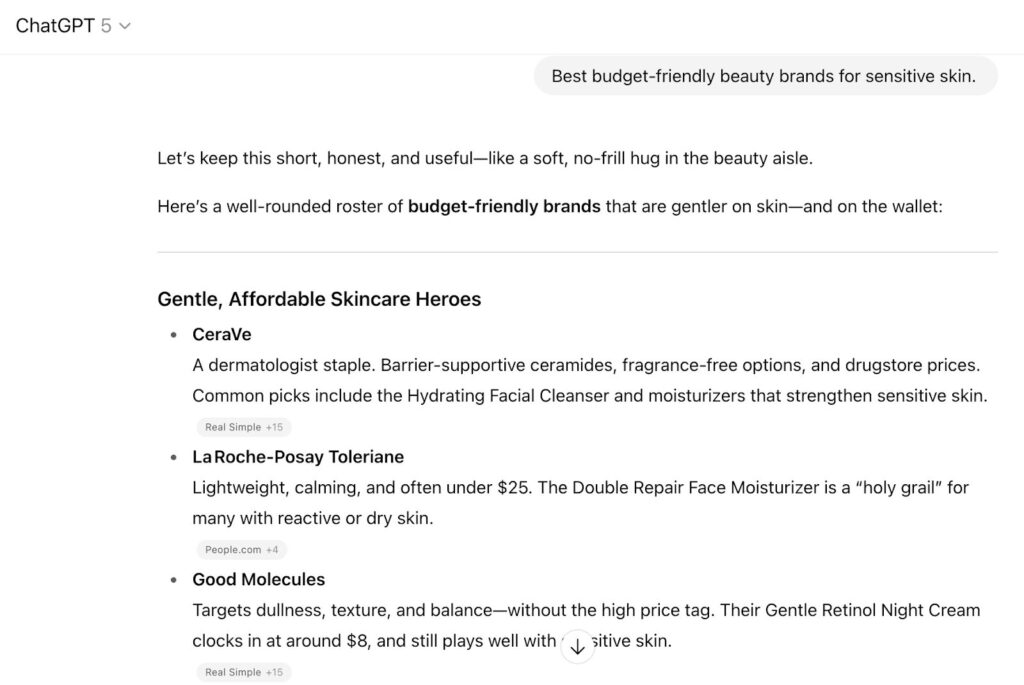
When a user asks ChatGPT for “best budget-friendly beauty brands for sensitive skin,” the response doesn’t surface brand websites or ads. Instead, it cites products featured in editorial outlets like Real Simple and People. This is why PR placements, not just owned content, are what AI answer engines lean on when making brand recommendations.
Media Coverage AI Can’t Ignore
PR has always been about credibility. Now it’s also about future-proofing discoverability in a zero-click, AI-driven search landscape. Agencies with strong media relationships can secure coverage in the exact outlets LLMs scrape, ensuring your story shows up in the answers people are actually reading, not just the links they used to click. To win at AI search, focus on outlets with strong domain impact scores, balancing bigger coverage with respected trade publications and trusted industry media that AI engines consistently pull from. The Muck Rack study highlighted that high-domain authority outlets like Reuters, Axios, TIME, Forbes, Good Housekeeping, and Investopedia frequently appear in AI citations. Reddit, YouTube, and Wikipedia matter too. They’re scraped in real time, and AI sees them as trusted, human-driven signals.
AI is forcing a return to authentic storytelling and trust-building. Brands that double down on earned PR today will be the ones ChatGPT recommends tomorrow.
TL;DR
- Earned media is the new SEO, and the foundation of Generative Engine Optimization (GEO).Earned media is the new SEO. AI pulls from credible articles, reports, and even unlinked mentions. 95% of AI citations come from unpaid sources—85% of which are earned media (Muck Rack, 2025)
- Freshness matters. Generative AI tools are regularly refreshed with new content, which means staying visible requires a steady drumbeat of PR coverage. The more consistently your brand appears in trusted outlets, the more likely it is to be pulled into AI answers.
- Authority signals matter. High-domain outlets (Reuters, Forbes, TIME, Axios, CNN) and niche publications (Good Housekeeping, Investopedia) frequently show up in AI citations.
PR powers GEO. Earned media is the direct path to future-proof visibility in AI search.
Ready to commit to a PR strategy that delivers lasting results? Get in touch with us today to learn how our team can create a PR program tailored to your goals.